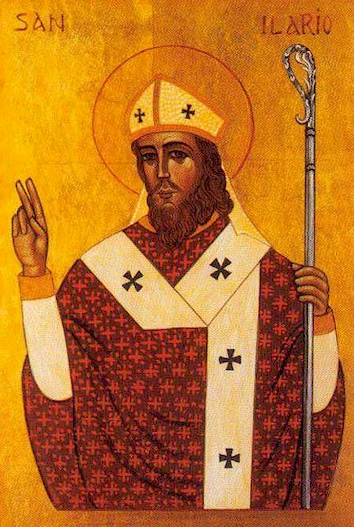
In the middle of the fourth-century Arian crisis — when the full divinity of our Lord Jesus Christ was being denied, weakened, or redescribed in ambiguous ways — St. Hilary, bishop of Poitiers, was exiled in 356 under the emperor Constantius II. It was during that exile in Asia Minor that he composed De Trinitate, one of the first major Latin works to engage the Trinitarian controversy in a sustained and systematic way. What St. Hilary was defending was the Nicene faith: that the Son is truly and eternally divine, not a creature, not merely the highest being below God, and not divine in some lesser or derivative sense. He was defending, in other words, what Christians now accept as foundational — the real Godhead of the Son and the unity of God, without collapsing the Father and the Son into the same person.
While working through Book X of De Trinitate, I encountered a passage that struck me not only for its theological precision but for how searingly it describes the universal human condition — a condition rooted, as the tradition teaches, in the distortions of original sin. St. Hilary writes:
“It is manifest that there is nothing which men have ever said which is not liable to opposition. Where the will dissents, the mind also dissents: under the bias of opposing judgment, it joins battle and denies the assertions to which it objects. Though every word we say be incontrovertible if gauged by the standard of truth, yet so long as men think or feel differently, the truth is always exposed to the cavils of opponents, because they attack, under the delusion of error or prejudice, the truth they misunderstand or dislike. For decisions once formed cling with excessive obstinacy, and the passion of controversy cannot be driven from the course it has taken when the will is not subject to reason. Enquiry after the truth gives way to the search for proofs of what we wish to believe; desire is paramount over truth. Then the theories we concoct build themselves on names rather than things: the logic of truth gives place to the logic of prejudice, a logic which the will adjusts to defend its fancies, not one which stimulates the will through the understanding of the truth by reason. From these defects of partisan spirit arise all controversies between opposing theories. Then follows an obstinate battle between truth asserting itself and prejudice defending itself: truth maintains its ground and prejudice resists. But if desire had not forestalled reason, if the understanding of the truth had moved us to desire what was true, instead of trying to set up our desires as doctrines, we should let our doctrines dictate our desires; there would be no contradiction of truth, for everyone would begin by desiring what was true, not by defending as truth that which he desired.”1
Anyone who has attempted to share the Gospel with others will recognize the frustration latent in St. Hilary’s words. There is a particular kind of exhaustion that comes from patient engagement with objections to the faith — from articulating, carefully and at length, how Christianity is not only internally coherent but speaks to the deepest questions of existence: the origin of contingent being, the ground of moral obligation, the meaning of suffering, the hope of death overcome. One draws upon two millennia of intellectual tradition, showing the inquirer that the great saints of Christendom — from Augustine to Aquinas, from Athanasius to Newman — have not left the hard questions unexamined. One addresses the nuances, meets the difficulties honestly, and demonstrates the remarkable depth of the Christian response. And yet, after all of this, none of it seems to land. The will of the listener has dissented before the mind has even begun to deliberate, and no argument, however sound, can dislodge what was never reasoned into place.
But then comes the harder reckoning — the moment of honest self-examination. When I turn the light of St. Hilary’s analysis inward, I find that I am no different from those I have struggled to persuade. I recall, for instance, my first encounter with Calvinism. I will freely admit that I found the doctrine deeply unappealing. Every theological tradition attempts, in its own way, to articulate how the sovereignty of God and the freedom of the human will can coexist, but the formulation I encountered — the stark, unvarnished version that circulates in online theological debate — was not pleasant to my ears. And what did I do? I spent the following weeks in a campaign of refutation, consuming video after video that marshaled arguments against it, seeking not truth but ammunition. I was not weighing the position fairly among a plurality of viewpoints; I was building a case for a verdict I had already rendered. And although sustained reading has since led me to conclude that the formulation does contain genuine errors, I cannot look back at the process I undertook without seeing my own face in St. Hilary’s mirror. Enquiry after the truth gave way to the search for proofs of what I wished to believe; desire was paramount over truth.
This recognition has taught me something about the ease with which I judge others while exempting myself from the same standard. It is tempting to tell myself that I have earned the right to expect rigor from others — that I have spent years reading, analyzing, and weighing the claims of Christianity alongside those of other philosophical and religious traditions, and that others ought to do the same. But here I am swiftly corrected by the Apostle Paul, who writes to the Romans:
“You, therefore, have no excuse, you who pass judgment on someone else, for at whatever point you judge another, you are condemning yourself, because you who pass judgment do the same things. Now we know that God’s judgment against those who do such things are based on truth. So when you, a mere human being, pass judgment on them and yet do the same things, do you think you will escape God’s judgment?”2
Paul’s admonition forces a deeper theological reflection on the nature of faith itself. Faith, properly understood, is a free act. The objects of faith are precisely those realities we cannot see and that are disclosed to us only by divine revelation. Because there is nothing extrinsic to the proposition that compels the intellect by sheer evidence — as a mathematical proof might — it is ultimately the will that commands the intellect to assent to what is proposed for belief. Faith is not irrational, but it is more than rational; it requires a movement of the whole person, intellect and will together, toward a truth that exceeds what reason alone can deliver.
It is here, at the intersection of will and grace, that I am able to reflect on the many seeds God has planted throughout my life to dispose my will toward the acceptance of His Gospel. The historical evidence, the philosophical arguments, the internal coherence of the Christian worldview — all of these contribute to the credibility of the faith. But credibility is not the same as assent. Ultimately, it is the movement of the will, prompted and sustained by the Holy Spirit, that constitutes the cause of belief. I know from my own experience that I did not want Calvinism to be true, and I knew full well that formidable arguments supported it. Yet my will had already determined the outcome and was prepared to marshal every available resource in its defense. If I can recognize this pattern in myself — the pattern St. Hilary diagnosed so precisely sixteen centuries ago — then I can begin to understand why others are not yet ready to accept the Gospel, even when I feel I have presented the case with force and clarity.
It is in this humility, hard-won and still fragile, that I have come to see myself in those I once judged. I have come to appreciate, with a gratitude that deepens over time, how God has worked patiently in my own life to soften a heart that was, in its own way, just as resistant as any I have encountered. And so the posture I now try to adopt is less one of argumentation and more one of prayer — not because argument is unimportant, but because I have learned that it is not finally sufficient. I seek to plant a seed where I can, and then to ask the Holy Spirit to do what no syllogism ever could: to soften the heart of another so that they, too, might freely receive the message of our Lord.


Leave a Reply